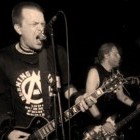

Not every band manages to deliver their most accomplished, hardest-hitting songs more than a decade into their career, but that’s exactly what Belgium’s LOTUS have done with their newest album.
Forever Martial is a raging, seething, and raw body of work, full of unexpected twists and turns. It’s one of those records that gets under your skin and begs to be played on repeat. If your collection includes Ceremony and Paint It Black, you’re going to need this in your life. Here’s what Jasper (guitar) and Jelle (vocals) had to say about it.
Forever Martial arrives a full nine years after The Road to Calvary, with only a split 7” with Ship of Fools in between. What did those nine years look like for the band, and when did this new album start to take shape?
Jasper (guitar): Has it really been that long? Besides the general slowdown during COVID, we also moved at a different pace for a while. Life outside the band started taking up more space.
We never really stopped being LOTUS, but with work, other projects, and everything else that comes with getting older, it became harder to consistently get the four of us in the same room.
Writing the songs for the split with Ship of Fools marked a turning point. It pulled us out of a creative standstill and made it clear there was still something worth pursuing. From there, things started moving again—slowly, but with more intent. Forever Martial wasn’t rushed. It built up over time and reflects a lot of what had been sitting beneath the surface for a while.
In my humble opinion, Forever Martial leans into all of LOTUS’ strengths: seething rage, fast and frantic songs, subtle hints of melody, and provocative lyricism. How would you describe the evolution you went through? Was there a roadmap when writing the album, or did it come together organically?
Jasper: We’ve always had a pretty clear idea of what LOTUS should feel like—direct, no excess, emotionally charged. That hasn’t changed. What did change is the level of urgency.
Compared to earlier material, this record leans much more into immediacy—faster, more confrontational, and with little room for anything that doesn’t serve the song. On previous records, we had slower tracks that interrupted that flow. This time, we were more conscious about keeping everything tight and pushing things forward. That also meant cutting or shortening parts that felt unnecessary or too familiar.
There wasn’t a strict roadmap, but we naturally gravitated toward a certain intensity. The goal was to make a record that never loses that. So it’s a continuation of what we’ve always done, just pushed further into its most essential form.
Sonically, the album is both coherent and abrasive, yet still leaves room for the songs to breathe. What was your approach to recording and mixing, and how intentional was that balance?
Jasper: That balance was very intentional.
We stripped things back to the essentials, but without letting the record feel flat. Working with Thomas at Hightime Studio again was key—he captures a natural, live-room sound that feels true to how we play. From there, Tim De Gieter and Jack Shirley helped shape it into something heavy and clear without polishing away the rough edges.
The goal was to keep the rawness intact without losing clarity—no overproduction, just capturing the energy of the songs in the most honest way possible.
There’s a sense of tension throughout Forever Martial, both musically and lyrically. Does the title reflect a specific idea or state of mind you were exploring?
Jelle (vocals): The album takes its name from the opening track, “Forever Martial,” which reflects a persistent state of unrest I’ve been carrying for well over twenty years now. And I don’t mean that in a heroic or triumphant kind of way. It comes from a place of mental and emotional burnout—being ground down by cycles of irrationality, violent anger, anhedonia, and fatigue.
As I grow older, resisting that unrest has become both more draining and increasingly necessary. I’ve seen from personal experience where it leads, and I hope to never get to a place so defeatist that there’s no way back. Forever Martial, the album, reflects that tension, but it isn’t about resolution or catharsis—it’s about endurance.
Living in a world that feels increasingly hollow—economically, politically, psychologically—has, for some, turned simply existing into an act of resistance. If you had to condense it into a central idea, it would be about staying combative, staying alert, and staying alive within yourself in the face of a struggle that feels endless.
But I wouldn’t consider Forever Martial a slogan or manifesto. It’s more of a quiet, realistic admission that “the fight” doesn’t ever really stop—and neither should your willingness to push back.
It’s become a rare thing, unfortunately, for bands to have lyrics as politically charged as LOTUS. Some of the songs on Forever Martial leave no doubt as to where you stand on topics like (Flemish) nationalism, fear- and hate- driven rhetoric, religious hypocrisy, and so on. Was this political and social awareness something that hardcore/punk awakened in you, or was it the other way around, being drawn to hardcore/punk because you already had that awareness?
Jelle: I don’t think we’re unique in bringing political ideas into this kind of music. If anything, I’d say we take a more nuanced approach compared to some more outspoken bands like Burning Kross, Travolta, The Headshrinker, Oust, Seein Red, Colère, and the late Haemers.
To answer your question, I’ve been listening to punk, second-wave ska, and hip-hop since secondary school, and those genres have definitely shaped my awareness. They gave language and urgency to injustices I wasn’t even consciously aware of at the time.
At the same time, I don’t think you gravitate toward this kind of music by accident—there’s usually something there already.
What punk and hardcore did was strip away abstraction and show me that you could confront things directly and emotionally. Over time, that becomes a feedback loop: lived experience feeds the music, and the scene feeds you new perspectives.
To paraphrase Dominic Owen Mallary, hardcore without punk is just a genre of porn. That’s how I measure its relevance—without that confrontational impulse, it becomes a hollow spectacle.
“Tyranny of Being” and “JLD” were the singles leading into the album. Do they best represent the record, or is there another track that captures LOTUS in 2026?
Jasper: Those songs definitely show two sides of the album. “JLD” captures the melodic drive, while “Tyranny of Being” leans into the aggressive side, especially with Bert stepping in vocally.
That said, every track on Forever Martial carries its own weight. Some are more layered in their unfolding—“Haunted Like a House” is a good example. The singles work as an entry point, but they don’t tell the full story.
LOTUS is often referred to as “Belgium’s best kept secret." How do you feel about that perception after 12+ years as a band? And how do you see the band’s place within the current Belgian landscape — are there bands you feel specifically connected to?
Jasper: We’ve never focused on reach or visibility in the traditional sense. It’s more about intent and having an outlet for what we do.
We’ve also always felt like the odd one out—too punk for hardcore, too hardcore for punk—but we see that as a good thing. It means we’re doing something honest. So being called a “best kept secret” makes sense, even if we sometimes wish it didn’t affect how often we get to play.
The Belgian scene has a lot of energy right now, especially with younger bands that aren’t tied to specific subgenres. We feel more connected to that broader movement than to any specific band or label. The biggest influence has always been the DIY BeNeLux scene. That “keep the bullshit to a minimum” mentality is something we try to live up to.
You’ve been working with Shield Recordings for quite some time now. How did that relationship come to be, and what does that collaboration look like today?
Jasper: Shield has always been closely tied to the DIY ethic we value. They support bands without overcomplicating things, and that no-bullshit approach is something we really respect.
Gert-Jan was already involved when we released our first record and has supported us ever since. When we told him we had a new one ready, he was immediately on board again. It’s simple in the best way—there’s trust, no unnecessary friction, and that fits how we like to operate.

Lastly, what’s next for LOTUS, and what have you been listening to lately that has inspired you?
Jasper: Right now, the focus is on playing shows and bringing the record to life live. That’s always been the core of what we do.
At the same time, I’ll be a first-time dad around the start of May, so Pieter from Cheap Drugs will be filling in for a few months. After that, we’ll continue as a five-piece.
As for listening, it’s usually a mix. Bands like Gouge Away, Blacklisted, and Mountain Man are still in rotation, along with Daniel Romano’s Outfit, Maggie Rogers, and The National. That constant flow keeps things fresh.
***
Forever Martial is available now via Shield Recordings.
LOTUS on social media: Instagram

Tagged: lotus