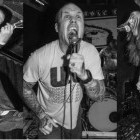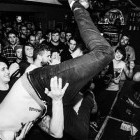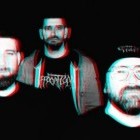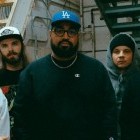
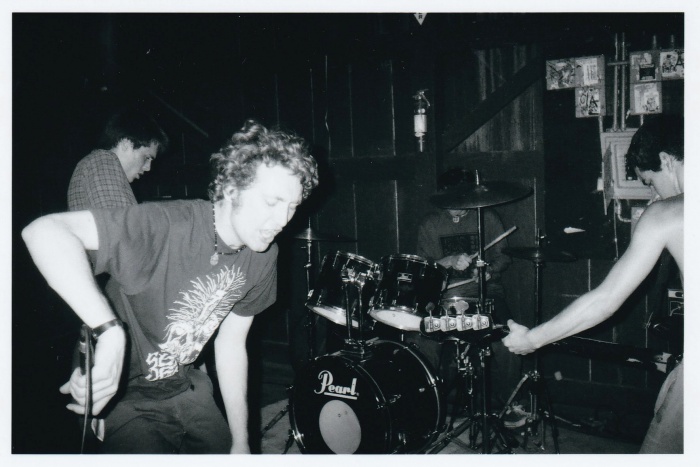
End of the Line didn’t last long, but that was never the point. Formed in the summer of 1991 out of the same creative nucleus that birthed Heroin, the San Diego band burned through a handful of shows, left behind a chaotic, volatile LP, and disappeared just as quickly as they arrived. In that short window, they captured something raw and unrepeatable—hardcore pushed to its outer limits, equal parts control and collapse.
“Relentlessly uncontrollable,” vocalist Cory Linstrum tells No Echo, a fitting description for a band that thrived on urgency and instability.
With End of the Line now stepping back into the spotlight decades later, Linstrum reflects on the band’s brief but impactful run, the environment that shaped it, and what it means to revisit something that was never meant to last.
End of the Line formed at a pivotal moment in San Diego's hardcore scene, with members transitioning from Heroin. How did it feel on the inside during that era? I was still in NYC at the time, and I paid close attention to the bands coming out of there.
In '89/'90, I was a roadie for San Diego’s Amenity. Anyone into local hardcore was going to see them. These shows are where people from different parts of town often met for the first time. Besides Amenity and Heroin, we had local bands Statement, Forced Down, Sub Society, Struggle, Drift, Blind Justice, Sloog, Funeral March, Pitchfork, and Fishwife (among others). I sang for a band called Brain Tourniquet. Heroin rented a band house, and they needed another housemate.
I was getting evicted from my apartment, so I moved in with them. This was an inspiring time, watching them work and evolve. Amenity soon broke up and became House of Suffering, without vocalist Mike Down (RIP). Mike D wanted to do one last hardcore project, enlisting Heroin members to back him, calling it End of the Line. House of Suffering and End of the Line would play their debut gigs together at the Che Café, with Brain Tourniquet opening.
Next, End of the Line booked some out-of-town dates with Struggle. Then Mike D suddenly quit. The Heroin side of the band asked me to step in as vocalist. I put Brain Tourniquet on simmer, did one rehearsal, and hit the road for a mini tour that took us to LA, Santa Barbara, and San Jose.
How would you describe EOTL's sound?
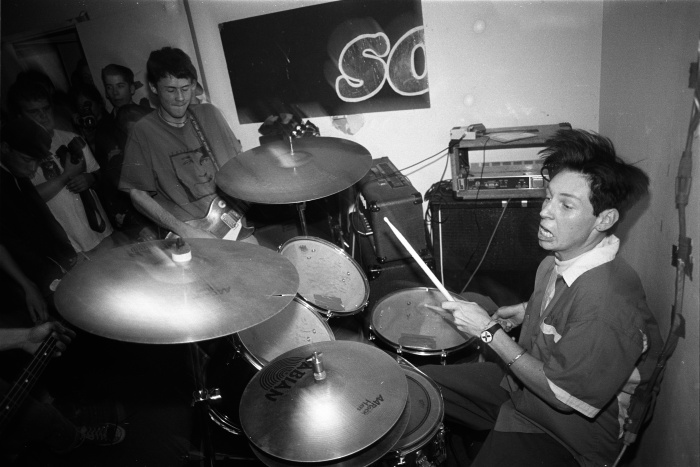
Relentlessly uncontrollable! Watching the band as a spectator, with Mike Down on vocals, I thought the band sounded a lot like The Faith. After I joined, we pushed it in a gnarlier direction. Matt A and I were both big fans of Septic Death, and I have that raw, guttural vocal style. Of course, we were going for a Void thing, as well. Which makes sense. Dynamic-wise, Matt A’s songs and riffs have a similar intensity to the guitar dynamics heard on Power of Expression by Bl’ast!
Did it feel like there was a lot of attention focused on the band from the start since you had folks in the lineup with a high profile, so to speak? What were those first couple of shows like?
The first show in San Diego, with Mike Down (Amenity, Forced Down, Inside Out) on vocals, was a big event. The three that followed, with me as frontman, were low-key. This was June 1991; Heroin hadn’t broken out of San Diego just yet – besides a handful of people in other cities that had the first seven-inch. Nobody knew who we were. That all changed by the next month.
We were invited back to Santa Barbara to open for Born Against and Rorschach at the Red Barn, and the East Coast contingent knew who Heroin was and had the records. They spread the word nationwide on EOTL, as well.
How do you feel about the LP today? What do you remember about the sessions? What was it like working with Kent at Ebullition?
Kent Mclard was great, very supportive, and booked us to open for so many cool bands. He invited us to contribute a track to the Give Me Back compilation LP, which also featured lots of cool bands. The EOTL LP came out nearly two years after the band had broken up. This was our fault. We accepted Ebullition’s record deal, knowing full well that I was going to be leaving San Diego by the end of Summer ’91, ultimately dissolving the band. Without an active band to promote it, Kent focused on his other releases and gave ours lower priority.
When recording it, we did two short sessions at small demo studios. Then, after I had left town, I returned for longer sessions at Double Time in San Diego’s East County. Jeff Forrest was the house engineer, but we produced it and mixed it ourselves (twice!). We were 20-21 years old and new to the recording studio, so the sound suffered due to inexperience. I began listening to it closely again after we remixed and remastered the Three One G version, and I dig it all over again.
How did the band take the news when you told them that you were leaving for the Bay Area? Outside of joining John Henry West, did anything else inspire the move up north?
They knew up front I was leaving town. That’s why we crammed so many shows into one summer. Ron, bass player for Heroin, was in Europe for a couple of months, so there was downtime with Heroin. We met Sarah Kirsch (Fuel, Torches to Rome, John Henry West) around this time, as I believe she was a roadie with Spitboy when they came to Southern California.
After about nine months in Oakland, I got a call to audition for the project that became John Henry West. But what inspired me to move to the Bay Area was the punk community. So many cool people and so many cool shows. I had been making the eight-hour drive up to Gilman Street since I graduated high school in 1989. Without hesitation, I traveled to see Nausea with Neurosis, Verbal Assault with Underdog, Swiz with Gorilla Biscuits, and many more.
That last EOTL performance with Fugazi and Jawbreaker has taken on a legendary status. What are your actual memories of that evening?
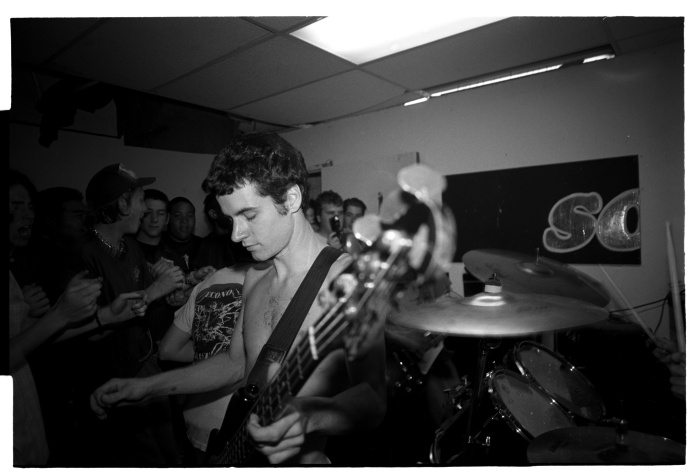
The Fugazi show at the Anaconda was special. A feather in my cap, for sure. This was a Santa Barbara show done by Kent McClard. He recently mentioned the crowd was over 2000 people – easily the biggest audience I’ve played for. I felt small on the huge stage and distant from the audience because of the security barrier. We didn’t let this separation bother us, though. Instead, End of the Line did what it was asked to do: play a ferocious set of hardcore songs.
I recently realized this wasn’t the band’s last performance, as we had thought. I traveled down South to do the Fugazi and Jawbreaker show in September 1991. I recently discovered a flyer dated February 1992 showing End of the Line playing with Born Against, Downcast, and Still Life at the same venue, but upstairs in the smaller-capacity room. This was the band’s last show.
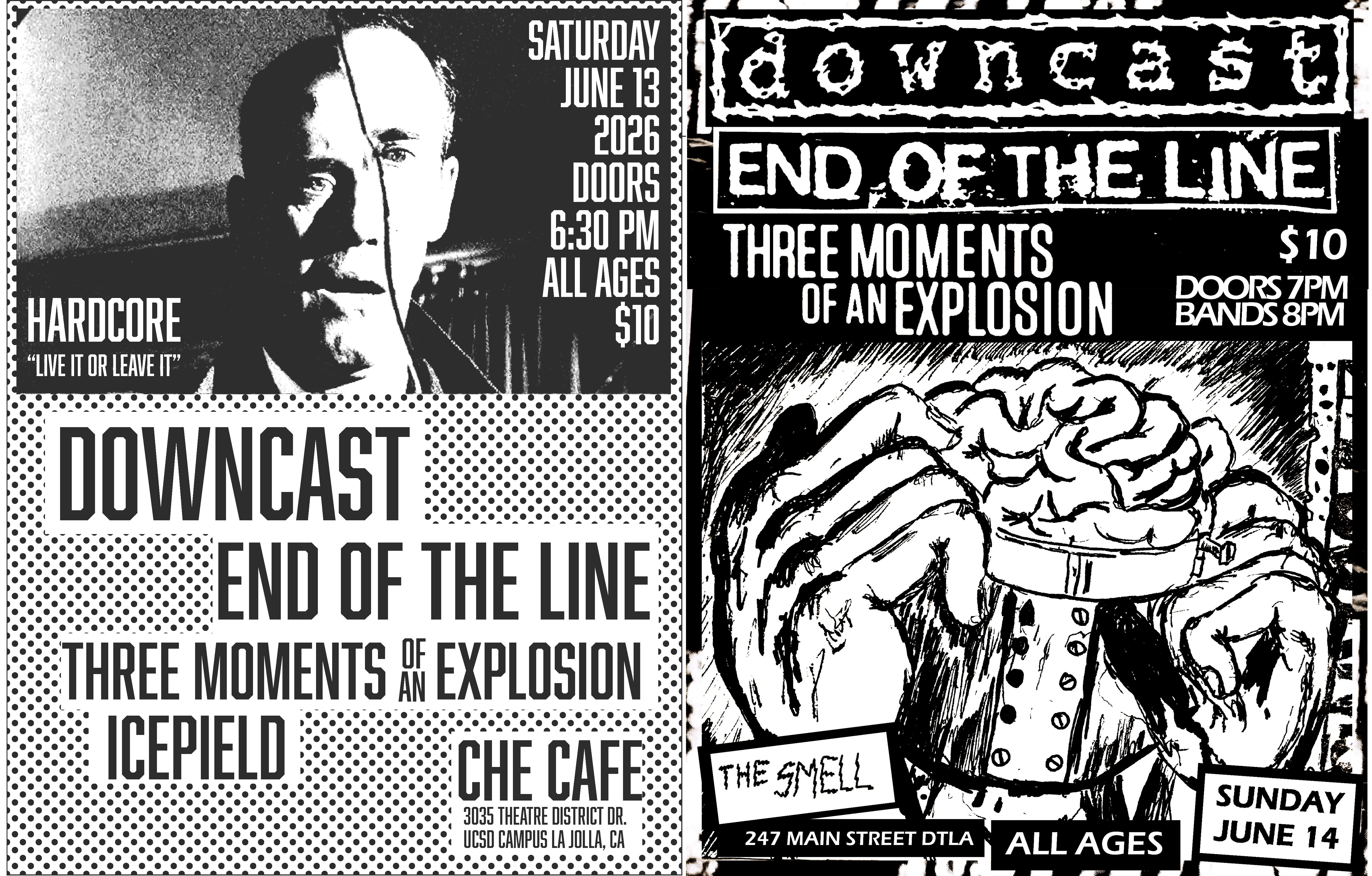
Now that the band is revisiting their past for these shows decades later, how does it feel to step back into something that was initially so fleeting and intense? Does it feel like a reconnection with that era, or is it something entirely different now?
I know people are listening to '90s DIY hardcore again, because my 18-year-old son is jamming Portraits of Past and Orchid. The feedback to our record being reissued a few years back was pleasantly surprising, as well. I had no idea the online response to our reunion would be so positive. Rehearsing with the guys again felt so natural. The chemistry is still there, despite a slight lineup change. We’ve added Ron from Heroin on 2nd guitar (Ron was End of the Line’s bass player during the Mike Down lineup).
Our next bass player, Scott, wasn’t interested in these shows, so we added one of our oldest friends, Adam, who designed the cover art for the record back in the day. I think it will be intense once we hit the stage. Judging by the messages and comments, this will definitely be a reconnection to the people and music of those times.
I refuse to be sentimental, though. We never stopped playing live music as individuals. We’re just playing music together again. There was some criticism about this being a nostalgia trip. I say no to that. Sure, these songs are 35 years old, but it's hardcore music, in-the-flesh, played the way it always has been.
As much as we love playing for the crowd, we play just as intensely for ourselves, which is extremely important to me. And for anyone wondering why we chose 2026 to do these reunion shows, instead of 2022, when the reissued record was released, well, it’s like this: Matt A was asked to fill in for the late Mike Down, playing guitar for the Forced Down reunion show, and he was hooked! Despite us being spread across California, in four different cities, we were all down to play music with friends again.
***
The Downcast x End of the Line shows will go down on June 13 at Che Che Café in San Diego, and June 14 in Los Angeles at The Smell.
The End of the Line vinyl LP reissue is available for sale via Three One G.
Tagged: end of the line