
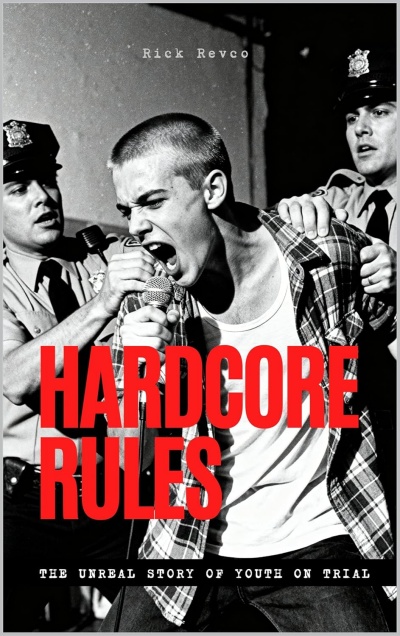
Some stories feel too real to be made up—even when they are.
Throughout Hardcore Rules: The Unreal Story of Youth On Trial, author Gary Strickland walks that line deliberately, drawing on lived experience while reshaping it into something more visceral. “A lot of my life is in there,” he tells No Echo.
“I wrote it under a pen name [Rick Revco], but a lot of it comes from personal experience,” Strickland explains. “I was the singer in a band called Hated Youth back in the ’80s, and a number of the moments in the book are pulled from that time, just reshaped into fiction.”
The novel follows Brent Calloway, a teenager navigating a fractured home life and finding an outlet in hardcore music, a world that offers both escape and confrontation. While the story is fictional, many of its details are rooted in reality. Strickland points to moments that translate almost directly from his own past: discovering punk through college radio, living in government housing, and even the violence at home. “My dad really did choke me out on a La-Z-Boy exactly as described in the book,” he says.
That sense of authenticity runs through the entire narrative. The anger that drives Brent isn’t manufactured—it’s pulled from something real. “I was a soft, sweet kid—but there was a rage inside me,” Strickland explains. “Hardcore was the thing that let me release it.”
In that way, Hardcore Rules isn’t just about a band—it’s about what draws people to hardcore in the first place. For Strickland, it wasn’t abstract. It was survival. The environment, the instability, the feeling of being overlooked or dismissed—all of it fed into the music.
READ MORE: Crunchface: New Book Celebrates '90s Ohio Hardcore Zine In All Its Attitude-Filled Glory
While the members of the band Youth On Trial are character composites, the dynamics between them are drawn directly from experience. “The details are real. The tensions are real,” he says, pointing to class divides, ego clashes, and the push-and-pull of creative control within a band.
That same tension extends beyond the band, shaping the emotional core of the story. Feelings of invisibility—at home, in the scene, in the broader world—run throughout the book. Strickland made a conscious decision to approach those themes through fiction rather than strict autobiography. “The story isn’t true, but every emotion in it is what I actually felt as a teenager,” he says. “I could make the feelings sharper than the facts.”
The title itself carries that dual meaning. Hardcore Rules references an actual song from Strickland’s past while also nodding to the contradictions within the culture—something that can be taken seriously, ironically, or somewhere in between. Like much of the book, it’s grounded in reality but reshaped through perspective.
That approach—using truth as a foundation and fiction as a tool—allowed Strickland to finally complete a project that had eluded him before. “The truth gave me the bones,” he says. “Fiction let me build whatever I wanted on top of them.”
The result is a story that captures hardcore not just as a sound or a scene, but as a force, something that pulls people in, shapes them, and in some cases helps them survive.
***
Hardcore Rules: The Unreal Story of Youth On Trial is available in paperback or eBook form on Amazon.
Tagged: book